Visuals
ESP CS2 interior FACEIT (guía + planes)
El ESP puede saturar interiores. Esta guía explica caja, vida y esqueleto — y cómo el producto Cheats CS2 reúne ESP, radar y aim para lobbies FACEIT.
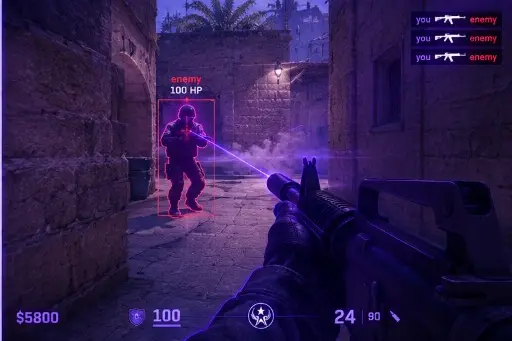
What ESP Overlays Actually Are
An ESP overlay is a set of graphics rendered over the game window that marks information the game itself would not show you in that way. Boxes, name tags, distance text, and skeleton lines are all examples. They are drawn by separate software, not by the game, which is why they depend on staying compatible with each game build.
Because they sit on top of the normal image, readability matters as much as the feature itself. An overlay that is technically working but visually noisy makes you slower, not faster, which is the opposite of what most people want when they enable it.
Boxes: The Simplest Overlay
Boxes are the plainest option: a rectangle around a player model. They are easy to parse at a glance because the shape is predictable. Thin outlines in a high-contrast color read better than thick filled shapes, especially against busy textures.
Indoors, boxes can overlap when several players stand close together. Keeping line weight low and avoiding fills keeps the scene legible. If boxes stack into a solid block on a narrow stairwell, the setting is working against you.
Health Bars and Text Information
Health indicators add a second layer: a thin bar or number next to the box. They are useful only if they are small and consistent. Large, animated, or multi-colored bars pull your eyes away from the crosshair and make the screen feel crowded.
Text elements like names and distance behave the same way. Show only what you will actually read in the moment. Our Patch Day Status article also notes that text layouts are one of the first things to look off after a game update, so a quick visual check after any patch is sensible.
Skeleton Overlays and Visual Clutter
Skeleton overlays draw a line figure over the player model. They can be informative but are also the busiest option. In small rooms with several models, a skeleton for every player turns the image into a diagram and hides the detail you are trying to read.
A practical rule is to treat skeleton lines as a situational choice and not a default. Many people prefer to leave them off in cramped indoor areas and keep simpler elements active. Whatever you choose, test it in a safe environment first so you are not judging legibility during a live round.
Performance and Compatibility
Every extra element has a cost. More drawing means more work per frame, and weaker systems can notice it as a small frame-time bump. Keep your overlays lean and watch your frame rate after changing anything.
Compatibility is the other half. An overlay that worked yesterday can behave oddly after a game or driver update. If drawing looks misaligned or missing, check the status first rather than adjusting settings blindly, and read Understanding aim assistance FOV for how visual and input features differ in how they are treated by communities and moderators.
Rules, Moderation, and Account Risk
Using overlays that reveal information in matchmaking, FACEIT, or any organized event violates the terms of those services. Enforcement can include permanent bans, loss of inventory access, and removal from leagues. Overwatch-style community review and demo checks also exist, and unusual play can attract attention regardless of tools.
We do not provide methods for avoiding detection, and nothing in this article guarantees safety. If you choose to experiment, do so understanding that you can lose an account. Keep it away from lobbies where rules are enforced, and never use it in a way that harms other players' experience in organized play.
Quick Review Checklist
Before you close the menu, run through these items.
- Boxes use thin outlines with a high-contrast color.
- Health bars and text are small and consistent.
- Skeleton lines are off or limited in cramped indoor areas.
- Frame rate stays steady after your changes.
- The status label matches the current game build.
- You have read the rules for any service you play on.
Por qué compradores usan el producto Cheats CS2
El hub del producto reúne ESP, controles de aim, overlay de radar y configs guardadas para Windows 10 y 11 en lobbies FACEIT. El estado se actualiza tras parches de CS2, la entrega es digital y hay soporte 24/7.
Qué plan te encaja
El mes cuesta 35 $ por 31 días; de por vida 150 $ sin contador de días. Compara en precios y planes.
Entrega, soporte y políticas
Tras pagar recibes email con enlace de descarga y notas del loader. Si falla la carga, soporte con tu ID de pedido. Reembolsos en FAQ y condiciones. Ayuda inicial: foro de setup.
Respuestas rápidas antes de pagar
¿Cuánto cuestan los cheats CS2?
Desde 35 $ al mes o 150 $ de por vida en precios del producto. Confirma el estado antes de pagar.
¿Qué tan rápida es la entrega?
Entrega digital por email, normalmente en minutos tras el pago.
¿Funciona en mi PC?
Pensado para Windows 10 y 11. Requisitos en la página del producto.
¿Listo para comparar módulos y planes?
Desde 35 $